There's a generation entering the markets right now that has never once thought of themselves as "opening a brokerage account." That phrasing belongs to their parents.
They grew up on Robinhood confetti, Discord alpha groups, and apps that pay out the second they're right. They treat market access the way they treat everything else — instant, mobile, gamified, and social. And the data on how they behave should make every broker CEO put down their CPA dashboard and pay attention.
Because this isn't a story about a new customer segment. It's a story about a different operating system for what "trading" even means.
01 — The behaviour: they don't invest, they engage
Start with frequency, because it rewrites every retention assumption brokers built over the last decade. According to Nasdaq's 2026 retail data, 49% of Gen Z investors trade weekly and 25% trade daily. Compare that to the old model of the "set it and forget it" investor who logged in once a quarter.
This generation didn't decide to trade more. The world trained them to expect always-on. Streaming, same-day delivery, instant payments — the consumer experience shifted to on-demand, and those consumers became investors who expect the exact same thing from their markets.
| Generation | Share who trade at least weekly |
|---|---|
| Gen Z | ~49% |
| Millennial | ~39% |
| Gen X | ~22% |
| Boomer | ~10% |
And they show up monthly almost without exception: 87% of Gen Z and 86% of millennials invest every month, versus 68% of boomers, per eToro's 13-country Retail Investor Beat. The engagement isn't a phase. It's the baseline.
02 — The products: the "trade" has been reinvented three times over
Here's where it gets uncomfortable for the traditional CFD and equities model. Gen Z's appetite hasn't just grown — it's migrated to entirely new products that didn't meaningfully exist five years ago.
Prediction markets: the new front door
Kalshi and Polymarket have turned forecasting into a tradeable asset class. Combined monthly volume jumped from under $5 billion in September 2025 to roughly $24 billion by April 2026, and the two platforms have cleared around $60 billion in combined volume so far this year. Bernstein projects the category hits $1 trillion by 2030.
The kicker for brokers: 32% of US Gen Z are already participating in prediction markets or considering it — versus 17% of the general population. For a 22-year-old, "will the Fed cut in March?" is a trade. It's binary, it's $0–$1, it resolves fast, and it feels like a bet on something they already follow.
Prop challenges: pay $50, control $100K
As one finance commentator put it bluntly: Gen Z and millennial traders don't want to slowly invest $500 in standard shares — they want to pay $50 to play a "challenge" and control a $100,000 demo account. The prop-firm model didn't just create a product. It packaged risk as a game with a leaderboard, and the generation that grew up on Fortnite understood it instantly. (We broke down the full broker-vs-prop shift in our prop firms analysis.)
Crypto, leverage and AI bots as default
Younger investors allocate around 25% of their portfolios to non-traditional assets like crypto and derivatives, per Coinbase research. And automation is already mainstream: roughly 67% of Gen Z crypto traders have activated at least one AI trading bot. The 22-year-old isn't waiting for your "advanced tools" tab. They're already running strategies your onboarding flow assumes they've never heard of.
- 50% of Gen Z want more risk
- 60% are taking on more risk than usual
- ~25% of portfolio in crypto / derivatives
- 75% of all retail trades on mobile
The classical market doesn't have a Gen Z problem. It has a translation problem. The demand is record-high — it just stopped routing through the products brokers built their funnels around.
03 — The old model vs the new expectation
This is the gap, laid out plainly. The left column is what most brokerages still optimise for. The right is what the incoming generation already expects as table stakes.
| Dimension | The Classic Model | The Gen Z Expectation |
|---|---|---|
| Entry point | Deposit your own capital, trade with leverage | Pay a small fee to access a challenge or contract |
| Feedback loop | Quarterly statements, slow compounding | Instant resolution, daily P&L, leaderboards |
| Product shape | Spreads, lots, margin | Binary contracts, funded accounts, gamified tiers |
| Discovery | Google "open CFD account," affiliate links | TikTok, Discord, prediction-market headlines |
| Tools | "Advanced charting" as a premium upsell | AI bots and automation assumed by default |
| Education | PDF glossary, a 2019 webinar nobody attends | Structured, on-demand, community-driven learning |
Notice that none of these are about being "younger and reckless." A separate Schwab read on December 2025 activity actually found Gen Z trading more cautiously than Gen X — scar tissue from the 2021 meme-stock cycle. The point isn't recklessness. It's that the shape of the product and the speed of the feedback changed. Adapt the format, and the demand is enormous.
04 — Why the classical market must adapt
There's a comfortable narrative that gamified trading is a fad and the serious money will always come back to "real" products. The volume data says otherwise. When NYSE's parent company invests up to $2 billion into Polymarket, and FTMO — a prop firm — acquires a regulated brokerage, the institutions have already voted. The new formats aren't the fringe. They're the on-ramp.
For the classical market, three things have to change — and they're the same instincts that separate the brokers winning Gen Z from the ones quietly aging out:
- Meet them at the format, not the product. A challenge, a binary contract, a gamified tier — these are acquisition channels, not gimmicks. The compliant version of the fun front-end is a moat, not a threat.
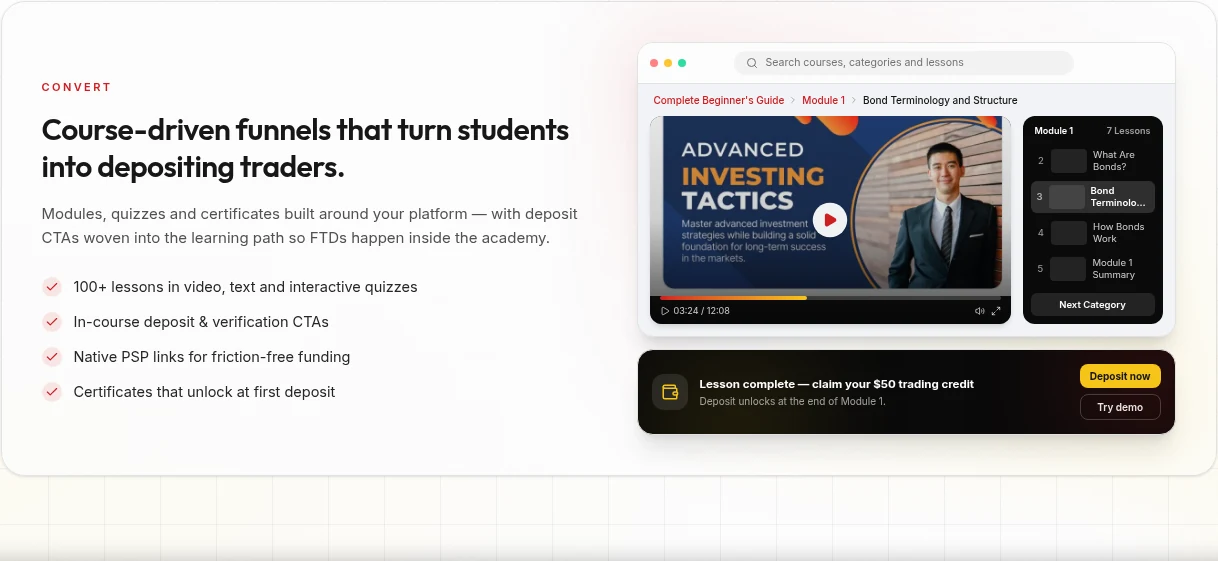
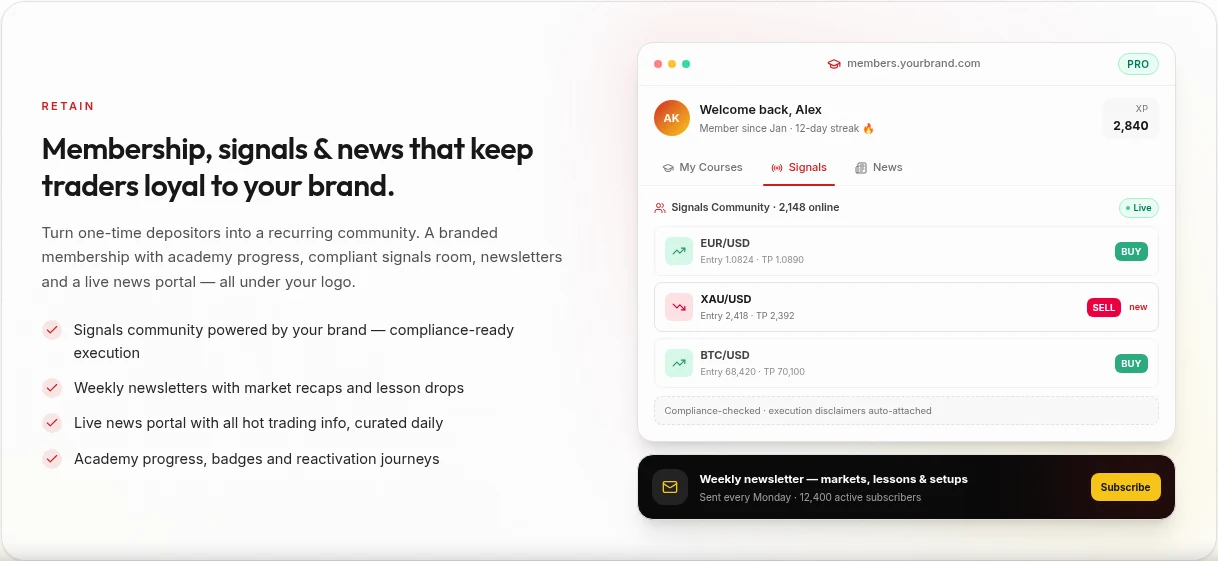
- Make education the product, not the disclaimer. This generation will sit through hours of structured learning if it's genuinely good and feels like levelling up. They will not read a PDF. Education is the single highest-leverage retention tool available — and it's still treated as a compliance checkbox by most. A white-label academy is how that gets built without rebuilding your stack.
- Rebuild around engagement metrics. If the KPI is still cost-per-FTD, you're measuring a model the market moved past. The generation that trades daily rewards platforms that feel alive: streaks, progress, community, instant feedback.
The brokers who treat this as a threat will spend the next three years defending a shrinking pool. The ones who treat it as the biggest acquisition opportunity in a decade will own the generation that trades 49% of the time instead of four times a year.
Gen Z and the new trading landscape FAQ
How often does Gen Z actually trade?
Nasdaq's 2026 retail data shows 49% of Gen Z investors trade weekly and 25% trade daily — far more frequently than older cohorts. eToro's survey adds that 87% of Gen Z invest at least monthly, versus 68% of boomers.
Why are prediction markets so popular with younger traders?
They're fast, binary, mobile-first, and tied to events Gen Z already follow — sports, politics, crypto, culture. Around 32% of US Gen Z are participating or considering it, nearly double the general-population rate. Combined Kalshi and Polymarket volume reached roughly $24 billion a month by April 2026.
Is Gen Z more reckless with risk than older generations?
It's nuanced. Surveys show 50% of Gen Z want to take on more risk and allocate around 25% to crypto and derivatives — but other data (e.g. Schwab) found them trading more cautiously than Gen X in late 2025, carrying scar tissue from the 2021 meme-stock era. The bigger shift is in product format and feedback speed, not pure risk appetite.
What does this mean for traditional CFD and equities brokers?
Demand is at record highs, but it increasingly routes through new formats — prop challenges, prediction markets, gamified and automated tools. Brokers who adapt the format (and lead with genuine education) capture the next generation; those who defend the old funnel face a shrinking, aging pool.
How should a broker adapt without breaking compliance?
Wrap the engaging, gamified front-end inside a regulated structure: funded-account pathways, structured education journeys, and engagement-based retention loops on top of existing compliance and infrastructure. The format is the acquisition channel; the regulation is the moat. Nexa's White Label Academy is built for exactly this.
The bottom line
Nexa Digital Studio builds turnkey educational academy platforms for CFD, crypto, and prop brokers who refuse to lose the next generation of traders to the competition. If this resonated, explore the White Label Academy — or let's talk.
References
- Nasdaq — Global Retail Executive Forum (2026), via International Finance.
- Pew Research Center analysis of The Block data (May 2026).
- SQ Magazine — Stock Market Participation Statistics (2026).
- eToro — Retail Investor Beat (Feb 2026). Opinium survey of 11,000 retail investors across 13 countries, Oct–Nov 2025.
- Bernstein, via CNBC (May 2026).
- Northwestern Mutual study, via Finance Magnates (2026).
- Coinbase research & Charles Stanley Direct, via Finance Magnates (2026).
- CoinLaw — Retail Investing Statistics (2026).
- BestBrokers / SQ Magazine (2026).
- Charles Schwab — Trading Activity Index, via Yahoo Finance (Jan 2026).
- ICE / NYSE investment in Polymarket (Oct 2025), via TRM Labs.
- FTMO acquisition of OANDA (completed Dec 1, 2025).