

Financial services marketing is how brokers, fintechs, financial institutions, and advisors build trust, attract qualified prospects, and retain clients. The strongest strategy combines clear positioning, credible branding, a conversion-focused website, useful content, and targeted digital distribution.
Build trust. Earn attention. Grow with intent.
In financial services, marketing isn't about visibility — it's about credibility.
Whether you run a CFD brokerage, a prop firm, a crypto platform, or you're an IB building a book, growth begins with trust. And in a market where every prospect has been burned by hype, bonuses, and "guru" noise, trust is the scarcest asset you have. The competitive shift explored in our analysis of how prop firms are capturing CFD brokers' best clients makes that trust gap impossible to ignore.
Clients today expect more than a tight spread or a sign-up offer. They want clarity, consistency, and confidence at every stage — from the first time they land on your site to the moment they fund and stay.
Each touchpoint either reaffirms that you're the right firm for them, or quietly hands them to a competitor. This guide covers the five pillars that turn marketing into sustainable growth — and where each one tends to break.
1. Strategy with a purpose
Before the design, before the campaigns, the question is simple: who are we actually here to help?
In financial services, where firms offer a wide range of products to a diverse audience, few answer that with certainty. Most market broadly, hoping to appeal to everyone — and resonate with no one.
The strongest firms narrow the focus. A brand converting first-deposit retail traders thinks differently from one nurturing experienced multi-asset clients. Same sector, completely different messaging.
Your positioning is your perspective and your promise: what you do best, who you do it for, and why it matters. When that's consistent from homepage to onboarding, it builds recognition and trust.
Strategy also means knowing what not to do. One well-qualified prospect who converts is worth more than a thousand passive impressions. Success isn't "more traffic" — it's better-fit, longer-retained clients.
Case study 01 — The “everyone” trap
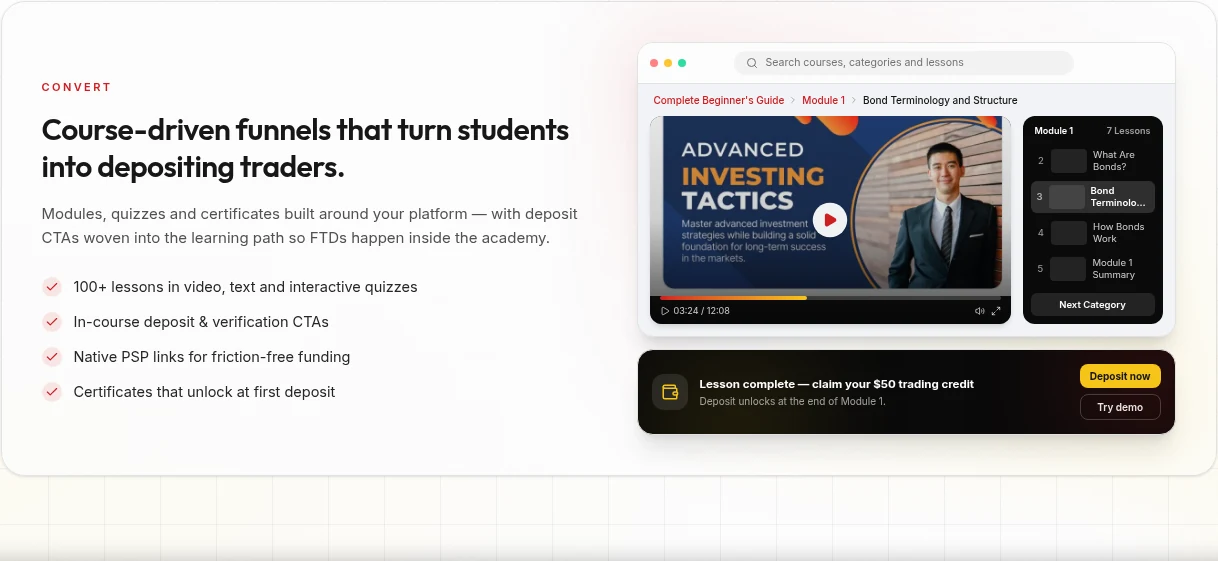
A mid-tier CFD broker runs one message at the entire market: beginners, experienced traders, and high-volume clients all hit the same generic landing page. Engagement is flat because nothing speaks to anyone in particular. By segmenting the academy into distinct tracks — a beginner foundations path and an advanced strategy path — each audience finally sees content built for them, and the same ad spend starts pulling more qualified, better-fit leads.
Illustrative model, not a specific client outcome.
2. Branding with intent
Branding in this sector isn't about being flashy. It's about being remembered, understood, and trusted.
In a market where every firm looks and sounds the same, your brand is one of the few tools that signals value before a single conversation begins. Clients want to understand who you are — and whether your approach feels honest rather than promotional — before they engage.
A strong brand isn't bold statements. It's quiet clarity that builds familiarity over time, lived through your visual identity, your tone of voice, and the structure of every page.
Professional doesn't have to mean cold, and credible doesn't have to mean jargon. Strip out the hype and the "trading is easy" promises, and speak plainly without losing authority. In a sector built on noise, that restraint is the brand.
Where reputation is tested
The fastest way to undermine a financial brand is to look like every other bonus-led operator. Firms that publish genuinely useful, honest material — rather than promotional copy — shift perception from "another broker" to "a brand that invests in my success." A structured, branded education layer is one of the most durable reputation assets a financial firm can own.
3. More than a website
For many firms, the website is an afterthought — built years ago, rarely updated, expected to "do the job."
But it's often the first meaningful interaction someone has with your business. Before anyone funds an account, they're assessing your layout, your message, your credibility.
Visitors scan; they don't read. They're seeking reassurance: Are you credible? Do you speak my language? Do you understand what I'm trying to do? Navigation should be simple, service pages instantly clear, CTAs natural rather than concealed.
Design for clarity, not decoration. Strong financial sites aren't flashy — they're well-structured. And they speak to goals, not products: clients don't think in "CFDs" or "spreads," they're asking whether they can actually do this without losing everything.
Case study 02 — The funding gap
A broker drives strong paid traffic, but most visitors leave without funding — interested, but not yet confident enough to commit. Adding a guided learning path as the on-site next step gives the undecided visitor somewhere to go besides the exit: a few structured lessons that build confidence and let them self-qualify. Instead of bouncing, they arrive at the funding decision already warm.
Illustrative model of how the academy closes the interest-to-deposit gap, not a specific client metric.
4. Content that earns trust
In financial services — where skepticism is the default and regulators are watching — content is how you prove value before asking for anything.
Don't list topics like a menu. Real clients are asking the human questions behind the products: Can I do this without losing everything? What does a real strategy look like? Why do most people fail?
Content that answers those honestly — including the uncomfortable parts — separates a credible firm from a lead-bait quiz. Keep it compliant by default; honest risk framing isn't a legal cost, it's a trust signal that compounds.
Case study 03 — Churn after the first deposit
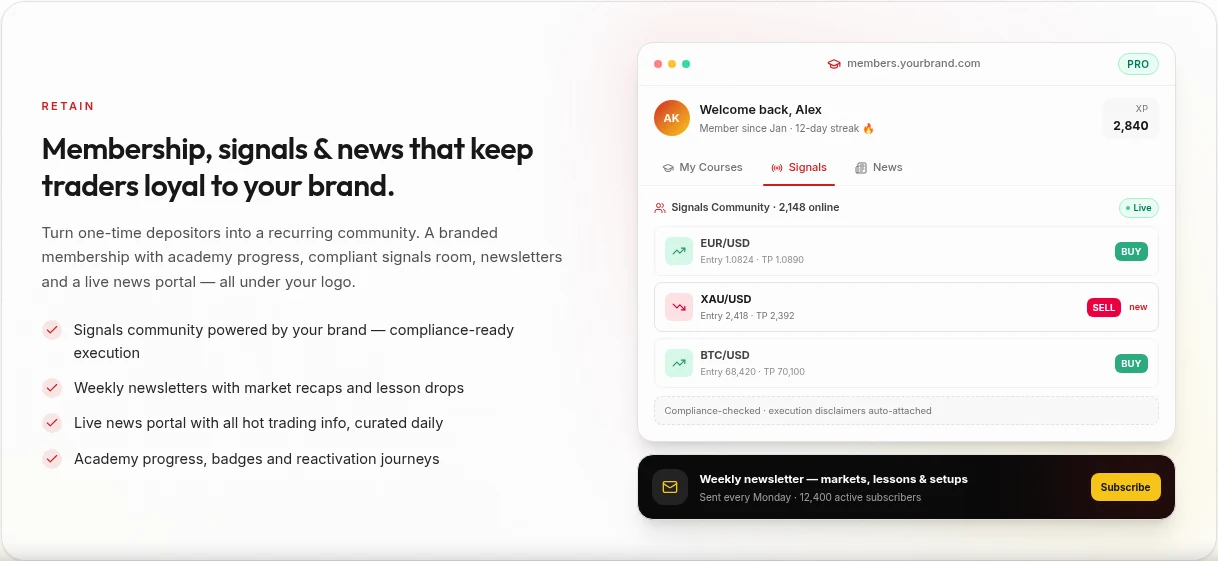
A firm wins deposits efficiently but loses clients fast: new traders fund, take early losses they don't understand, panic, and leave before they ever become profitable. A structured education programme — risk management, realistic expectations, strategy fundamentals — gives those traders the context to stay calm and stay engaged. Better-informed clients trade longer and churn slower, turning a first deposit into a relationship instead of a one-off.
Illustrative model of the retention mechanism, not a specific client figure.
5. Digital with direction
A great offer nobody finds converts nobody.
Digital is where reach meets intent — targeted SEO so the right clients find you organically, paid media that points to genuine value rather than empty bonuses, and affiliate or IB channels that extend reach without diluting the brand.
Spend where intent is highest. One funded client from organic content that ranks for years beats a thousand paid impressions that vanish at midnight.
And the strongest distribution assets are the ones others want to share — useful, credible material that IBs and partners are happy to put their name next to, because it makes their traffic warmer and their job easier.
Case study 04 — Arming the IB network
An IB struggles to stand out as just another affiliate link competing on the same offers as everyone else. Given a branded academy to share instead of a bare referral link, the IB now leads with genuine value — education that warms the audience before any broker handoff. The material does the trust-building, the relationship does the converting, and the IB becomes a channel partners actually remember. For a deeper look at this model, read our complete guide to building an Introducing Broker business.
Illustrative model of the IB distribution dynamic, not a specific partner outcome.
Bringing it all together
Five pillars, one direction. Strategy gives you focus. Branding earns the trust. The website converts. Content deepens the relationship. Digital scales it.
Across all five, the recurring theme is the same — conversion, retention, reputation. In a sector that's run on hype and bonuses for too long, the firms that win are the ones that educate honestly and build trust on purpose.
That's why a structured, branded education layer keeps surfacing as the answer. It's where your three most expensive problems — traffic that won't convert, clients that won't stay, and a brand that looks like everyone else's — quietly converge into one asset you actually own.
Financial services marketing FAQ
What is financial services marketing?
Financial services marketing is the strategy financial institutions, brokers, fintechs, and advisors use to attract, convert, and retain clients. Because financial decisions carry risk, effective marketing combines credibility, compliance, education, and a clear customer journey.
How do you market financial services effectively?
Start with one well-defined audience, build credible positioning, answer trust and risk questions on the website, publish useful educational content, and distribute it through SEO, paid media, email, and partner channels. Measure qualified leads, funded accounts, retention, and lifetime value—not impressions alone.
What is trust-led marketing in financial services?
Trust-led marketing focuses on building credibility through transparency, education, and honest communication rather than high-pressure sales tactics or flashy bonuses. In a skeptical market, it is the most effective way to win long-term clients.
How do you reduce client churn in brokerage marketing?
Churn is best reduced by managing expectations through education. Providing traders with the tools and knowledge to manage risk and understand market volatility keeps them engaged longer than promotional offers do.
What is the most effective marketing channel for forex brokers?
While paid media drives volume, organic SEO and established IB networks often provide higher-quality, longer-retained clients. Educational content acts as the "glue" that makes these channels perform better by warming up leads before they reach the platform.
Does digital marketing work for financial services?
Yes. SEO, content, paid search, email, and partner marketing work when the message is specific, useful, and compliant. Digital campaigns perform best when they lead to genuine education rather than generic promotions or bonus-led landing pages.
Ready to turn marketing into measurable growth?
Nexa Digital Studio builds the education layer that fixes the leak — branded to you, built for conversion, retention, and reputation. Book a 40-minute discovery call →